


Why Pressure Is Costing You More Than You Think

(And Why “Functioning” Isn’t the Same as Stability)
Most people don’t think of themselves as overwhelmed.
They’re getting things done. They’re showing up. They’re handling responsibilities, managing relationships, and meeting expectations.
From the outside, it looks like functioning.
But functioning under constant pressure is not the same thing as being stable.
And that distinction matters more than most people realize.
Pressure Is a Strategy — Not a Strength
For many high-functioning people, pressure became a coping mechanism early on.
Deadlines. Urgency. Self-talk that sounds like, “Just push through.” A quiet belief that if you ease up, everything will fall apart.
Pressure worked - until it didn’t.
What often gets mislabeled as “lack of discipline” or “inconsistency” is actually something else entirely: A nervous system that’s been asked to perform without support for too long.
The Hidden Cost of “Holding It Together”
Pressure creates short-term results, but it comes with a long-term tax.
Over time, people start to notice:
They can’t sustain the routines they want to keep
Small decisions feel exhausting
Emotional reactions feel bigger than the situation warrants
Recovery takes longer
Motivation feels unreliable
And instead of questioning the system they’re operating within, they question themselves.
Why can’t I just be more consistent? Why does everything feel harder than it should?
The problem isn’t effort.
The problem is instability disguised as responsibility.
Stability Is Not Calm — It’s Predictability
Stability doesn’t mean life is peaceful all the time.
It means your system knows what to do when life gets loud.
It means:
You recognize your personal disruptors
You understand what drains you - not just what stresses you
You can return to baseline without forcing yourself to “reset”
Stability reduces the amount of self-management required just to function.
And when stability increases, consistency stops feeling like a battle.
What If the Goal Isn’t to Push Harder?
Most personal growth messaging encourages people to:
Try again
Commit more
Be disciplined
Raise the bar
But what if the smarter move - especially in January - is to lower the friction instead?
Before you add habits, goals, or expectations, ask:
Where am I relying on pressure to stay functional?
What parts of my life require constant effort just to maintain?
What patterns repeat when I’m tired or emotionally stretched?
These aren’t failures.
They’re personal data.
And data is where precision begins.
Precision Over Perfection
Precision isn’t about doing everything right.
It’s about doing what actually works - consistently, sustainably, and without self-punishment.
That starts by identifying what quietly destabilizes you:
Overloaded mornings
Lack of recovery between responsibilities
Emotional labor that goes unacknowledged
Internal pressure to “be fine” instead of being supported
You don’t need to fix yourself.
You need to redesign the way you operate.
A Different Way to Start the Year
January doesn’t have to be about reinvention.
It can be about refinement.
It can be the month you stop performing survival and start building a system that supports peace and performance.
Not through intensity. Through precision.
Anchor Thought...
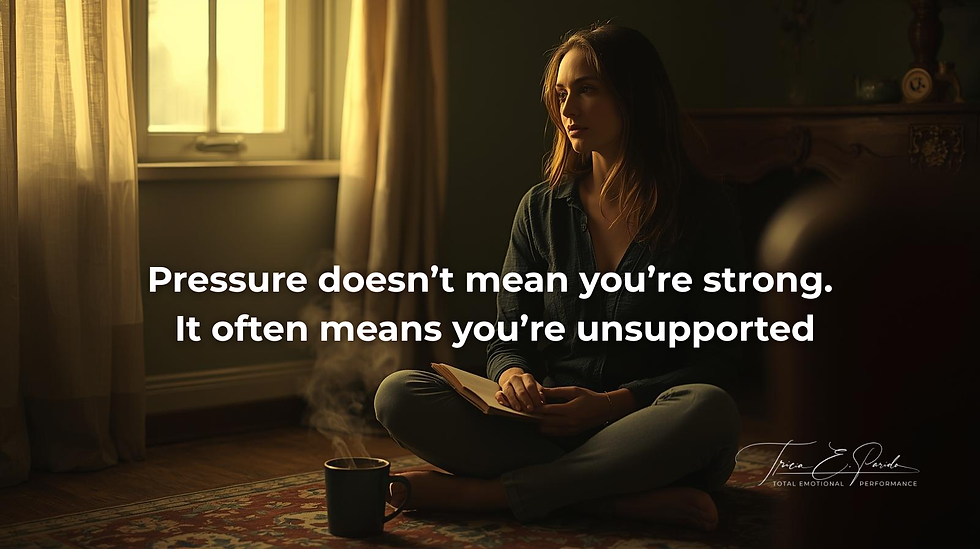
Pressure doesn’t mean you’re strong. It often means you’re unsupported.
If this perspective resonates, it’s because you’re ready for a different way of working with yourself ... one built on emotional precision, not pressure.
That work begins with personal awareness.



Comments